Use DMZ-Red mouse cursor as default

Find a download site for the DMZ-Red mouse cursor theme and download the tarball to ~/140570-Cursors.tar.gz.

Expand it under /usr/local and fix permissions :

sudo mkdir -p /usr/local/share/icons
cd /usr/local/share/icons
sudo tar xvzf ~/140570-Cursors.tar.gz
sudo chmod -R go-w DMZ-Red

Edit the *.theme files so that they look like this :

$ cat /usr/local/share/icons/DMZ-Red/cursor.theme
[Icon Theme]
Inherits=DMZ-Red

$ cat /usr/local/share/icons/DMZ-Red/index.theme 
[Icon Theme]
Name=DMZ (Red)

Link into /usr/share/icons :

sudo ln -s /usr/local/share/icons/DMZ-Red /usr/share/icons

Configure as system-wide default :

sudo update-alternatives --install /usr/share/icons/default/index.theme x-cursor-theme /usr/share/icons/DMZ-Red/cursor.theme 100

sudo update-alternatives --config x-cursor-theme

The last command should come up with a list of choices and a prompt similar to this :

There are 4 choices for the alternative x-cursor-theme (providing /usr/share/icons/default/index.theme).

  Selection    Path                                     Priority   Status
------------------------------------------------------------
* 0            /usr/share/icons/DMZ-Red/cursor.theme     100       auto mode
  1            /usr/share/icons/Adwaita/cursor.theme     90        manual mode
  2            /usr/share/icons/DMZ-Black/cursor.theme   30        manual mode
  3            /usr/share/icons/DMZ-Red/cursor.theme     100       manual mode
  4            /usr/share/icons/DMZ-White/cursor.theme   50        manual mode

Press <enter> to keep the current choice[*], or type selection number: 

In XFCE, the “Settings – Mouse and Touchpad – Theme” dialog should look like this :

Enter passphrase once at X login for ssh, scp, sshfs

I use ssh, scp, sshfs and x2go with key-based authentication, ie. not entering remote passwords when I connect. There are pros and cons of this, but I think it is more secure.

I use a non-empty passphrase but do not want to enter it on every connection. Once per X session is enough for me.

Here is how I set it up on Debian 11 (“bullseye”):

# do this once and set a good passphrase:
ssh-keygen
# then for each of your accounts on remote hosts:
ssh-copy-id username@otherhost

Configure ssh agent and ssh-add to run when your X session starts. I use the gnome-keyring service as agent:

sudo apt install gnome-keyring

In XFCE – Settings – Session and Startup – Application Autostart, I have two entries with trigger “on login” :

  • “SSH Key Agent (GNOME Keyring: SSH Agent)”
  • “ssh-add” – created by me, command: ssh-add

This setup will bring up a visual prompt for your ssh passphrase right after XFCE login. The default ssh-askpass looks quite ugly, so I installed a more modern one:

sudo apt install ssh-askpass-gnome

On Debian, that package sets itself as default ssh-askpass “alternative”. If in doubt , try this:

sudo update-alternatives --config ssh-askpass

The resulting prompt looks like this for me (“Adwaita Dark” theme):

After all this your ssh, scp, sshfs, x2go and other ssh based tools should be able to connect to your remote accounts without password prompts.

Update: I took convenience one step further and enabled “Launch GNOME services on startup” in the Advanced tab of Session and Startup in the XFCE setting, as described in the XFCE wiki.

This activates GNOME Keyring which “is integrated with the user’s login, so that their secret storage can be unlocked when the user logins into their session”. This means it will store your once entered ssh passphrase on disk, using your Linux login as the only secret that you still have to enter (as you log in as usual).

Hide window from taskbar

Some application windows are sort of “background noise” and you would usually not like to see them on your taskbar, i.e. on the panel item that shows a button for each application window. Often, applications like that support a “minimize to system tray” option, but some don’t.

In the latter case you might at least want to have a convenient way to hide those windows from your taskbar. I did the following on Debian stable:

Install the “wmctrl” package:

sudo apt install wmctrl

In my XFCE, I added a launcher to the panel, specifying the command:

wmctrl -r :SELECT: -b add,skip_taskbar

See “man wmctrl” for details.

Webex web client in Firefox could not acquire local media

If you run Webex Teams – i.e. http://teams.webex.com – in Firefox and join a video meeting, you might see the error

Could not acquire local media. Please check your settings.

This probably means that support for the H264 video format is missing.

Go to “about:config” and search for

media.gmp-gmpopenh264.enabled

and set it to “true”.

Restart Firefox, and go to “about:addons”, click “Plugins”.

The plugin “OpenH264 Video Codec provided by Cisco Systems, Inc.” should now be installed, and video calls in the Webex web client should now work.

Server folder as photo gallery in web browser

I wanted to make image folders on our family file server browseable and provide convenient image gallery features like index view, slideshow, etc.

The file server is on our home network and runs Debian GNU/Linux.

I installed webfs, configured it to use port 80 (instead of its default port 8000), added a symbolic link to the root folder of the image folders that I wanted to make browseable (/opt/data in my case) and restarted webfsd:

sudo apt install webfs
sudo sed 's/web_port=.*/web_port="80"/' -i /etc/webfsd.conf
sudo sed 's/web_root=.*/web_root="/var/www/html"' -i /etc/webfsd.conf
sudo sed 's/web_index=.*/web_index="index.html"/' -i /etc/webfsd.conf
sudo ln -s /opt/data /var/www/html
sudo service webfs restart

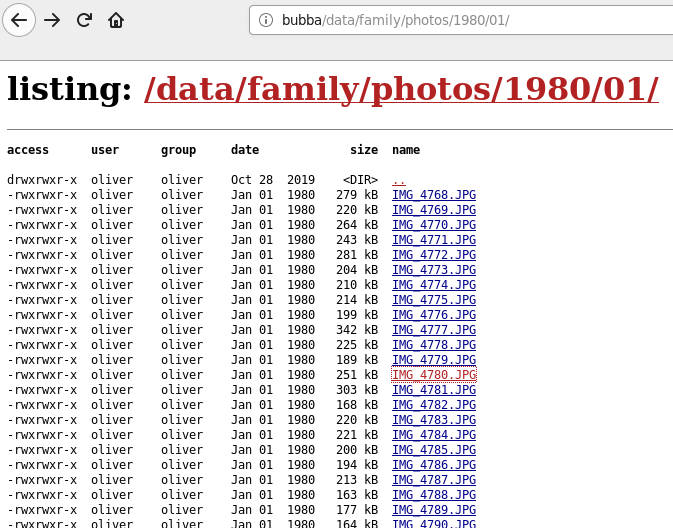
The name of the server is “bubba” and at this point pointing a web browser to http://bubba/ already worked, but it only showed a simple listing of file names like this:

Next I installed the Slideshow Firefox add-on on all our computers, and now the image folder is presented like this:

Mission accomplished! 😀

Cleanbrowsing DNS + dnsmasq

I have children and I want to keep porn out of our home network.

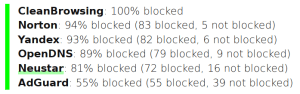
Cleanbrowsing DNS provides a free “Family” filter. You can set your router to use their DNS servers. It seems quite good in comparison to other DNS filters:

However, their filter is sometimes a little strict and even blocks reddit.com and, curiously, the Haligonian event magazine website thecoast.ca.

On the other hand, it does not block user-uploaded images on Twitter, and its many porn peddling accounts.

So basically what I wanted was a configurable whitelist and blacklist on top of the Cleanbrowsing Family filter.

To do that, I installed dnsmasq on a Linux server in our network and configured the DHCP server on our router to give out the IP address of that Linux box as DNS server, effectively directing all machines on our home network to get their DNS from the dnsmasq installation.

I configured dnsmasq as a proxy that by default passes on all DNS request to the Cleanbrowsing Family filter:

This is the content of /etc/dnsmasq.d/cleanbrowsing.conf :

# ignore /etc/resolv.conf
no-resolv
no-poll

# use cleanbrowsing family nameservers as default
server=185.228.168.168
server=185.228.169.168

This is currently the content of /etc/dnsmasq.d/whitelist.conf :

server=/reddit.com/1.1.1.1
server=/thecoast.ca/1.1.1.1

This is currently the content of /etc/dnsmasq.d/blacklist.conf :

# block twitter user media servers (porn and tracker pixels)
server=/pbs.twimg.com/
server=/video.twimg.com/

Whenever I edit any of the above I have to restart the dnsmasq service.

The files in /etc/dnsmasq.d are read by default on my Debian GNU/Linux. If you use a different distro you might have to adjust /etc/dnsmasq.conf accordingly, look for the “conf-dir” directive.

If your router allows you to configure outgoing firewall rules, block all DNS requests from anywhere but the dnsmasq server, to prevent a savvy teenager from bypassing your DNS filter.

Setting up a free C64 emulator for retro game fun

I just installed the C64 emulator VICE on an old Windows laptop and set it up with shortcuts for some old time games that I used to play in the 80s.

My 6 year old son really likes Donald Duck’s Playground where you do odd jobs as Donald to earn cents and dollars to buy playground equipment for your nephews and let them play:

Setting up the game required the download of a zip archive containing a *.d64 image file that can be autostarted by VICE. I created a desktop shortcut to the x64.exe file in VICE with the path of the d64 file as command line parameter. That gives you a shortcut that will start VICE and autostart the game right away. Add the -fullscreen option to start the emulator in fullscreen mode.

I had to enable keyboard mapping for Joystick 2 as shown on the WinVice c64-Wiki.

VICE is a cool emulator that runs on Unix, MS-DOS, Win32, OS/2, BeOS, QNX 4.x, QNX 6.x, Amiga, Syllable or Mac OS.

Games I might try next include Spy vs Spy, Aztec Tomb, Q-Bert and I few others. :)

Recursively compare content of two directories

Command line

This requires the diff and vim packages.

diff --recursive /dir/ect/ory1 /dir/ect/ory2 > 1_vs_2.diff
vimdiff 1_vs_2.diff

Potentially useful diff options:

--ignore-all-space
--exclude=.svn

GUI

Install Intellij CE.

Then either Run IntelliJ Diff from the command-line.

Or from within a running Intellij window:

  • Open a common parent directory as a project
  • Select the two directories to compare
  • Right-click – Compare Directories

Alternatives

I often see the GPL-licensed WinMerge tool recommended, But it works only on Windows, last release was 2013 and navigation into sub-directories and file diffs is a bit clunkier than in Intellij.

Redshift to reduce eye strain from nightly computer use

Note: This tutorial is mainly for Linux users. For other operating systems you could consult the article “Best Automatic Display Adjustment Software for Mac, Windows, iOS and Android“.

Redshift is a little Free and Open Source tool that can reduce the blue component in the light emitted by your computer screen. By default, it does so between sunset and sunrise based on your latitude / longitude coordinates, but you can also use a permanent fixed light temperature.

The underlying idea is that too much blue light can strain your eyes, especially at night.

Permanent candle light

On Debian and derivatives like Ubuntu, the redshift command line version can be installed like this:

sudo apt-get install redshift

I personally like a “permanent candlelight” setting at all times. This simple example sets a relatively low fixed light temperature of 1800K (see man redshift for more details):

redshift -O 1800

If you like this approach, you can run this command at X session start, similar to what is shown under “Autostart after Login” below.

Or set a bash alias like this:

alias candlelight='redshift -O 1800'

To reset your screen color temperature use this command:

redshift -x

Emulating Day and Night

If you want redshift to distinguish between day and night, it is convenient to use the GUI version with a config file that specifies your latitude and longitude as shown below.

On Debian and derivatives like Ubuntu, redshift with the GTK UI can be installed like this:

sudo apt-get install redshift-gtk

You can determine your coordinates by googling for the name of your town or city, combined with the words “longitude” and “latitude”, for example for the German town of “Rodgau” this would be: https://google.com/search?q=rodgau+longitude+latitude

Note that latitudes south of equator and longitudes west of Greenwich must be specified as negative values. The following shows an example ~/.config/redshift.conf for Halifax (44.65° North, 63.58° West), with 1800K candlelight at night and a mild 3600K during the day:

[redshift]
temp-day=3600
temp-night=1800
location-provider=manual

[manual]
lat=44.65
lon=-63.58 

Run the tool for the first time either via Start Menu – Accessories – Redshift on Debian systems, or as redshift-gtk on the Linux command line.

You should then be able to see a reddish light-bulb icon in the system tray (aka “notification area”) of your desktop system. Clicking on it gives you options to temporarily disable the tool or view info about your configured geo-location and whether redshift thinks it is currently night-time. If so, you should notice a reddish screen color temperature.

Autostart after Login

To have redshift-gtk start up on every X session, add an entry to the Autostart mechanism of your desktop environment or window manager.

For XFCE on Debian, open Start Menu – Settings – Session and Startup – Application Autostart tab and add an entry like this:

add-redshift-to-xfce-autostart

Further reading